Aug/112
Consumer Solar Kit Gets Cheaper

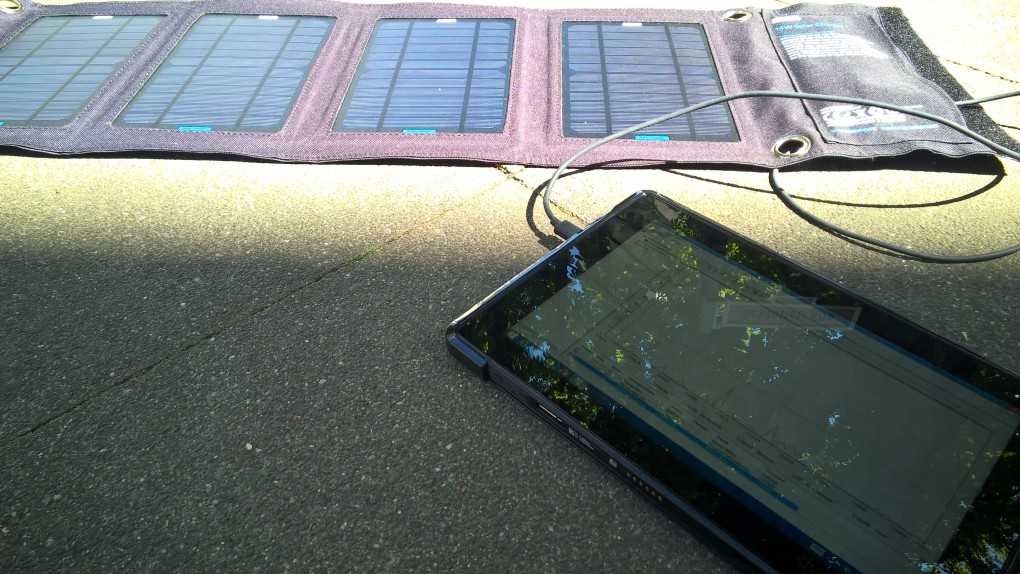
Spotted in my local hardware supermarket today was a surprisingly cheap 12v solar kit.
The 15w solid panel was packaged with a regulator / converter that had various output voltages, two led lighting solutions and a 7ah 12v battery. The 220v inverter shown in the image was not included in the kit.
The price? A reasonable €149
While the build quality didn’t look that great, this would still be a good purchase for emergency use.
The price also indicates that some mass manufacturing is starting for the consumer market now. Certainly the Summer 2011 edition of a local electronics catalogue shows way more solutions and products than just a few years ago.
Have you seen more consumer solar equipment for sale this year?
Jun/111
NC215S Samsung Netbook with (Est… 4W) Integrated Solar Panel.
Samsung make, in my experience, some of the most efficient netbooks and laptops in the market. Over the last 5 years I’ve repeatedly seen idle / background drain figures that are better than anything else which is why I’m looking forward to testing the Samsung TX100 when it launches. Based on Intel’s Oaktrail it should be capable of some extremely low power drain and as a travel PC for use with solar or other alternative energy sources, nicely positioned.
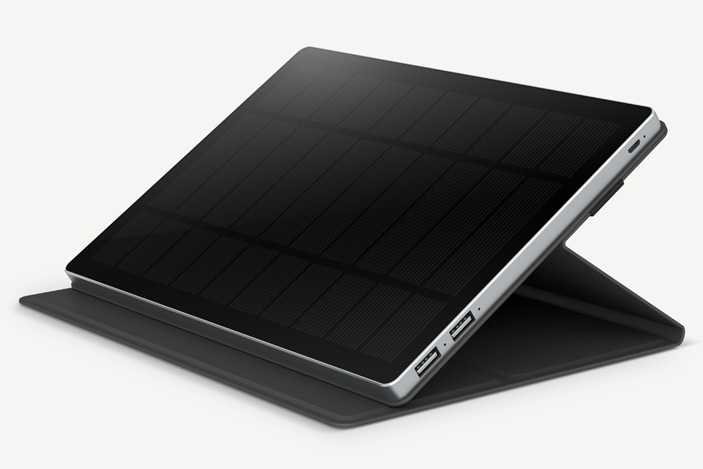
There’s another Samsung netbook out there though that has taken the alternative energy idea one step further. Meet the NC215S with integrated solar panel.
The NC215S is for African, Turkish, Slovakian, Russian and other markets initially and although there’s no indication of the size of the power of the panel, I would put it at a maximum 4W which, given a 75% charge efficiency, would be enough to meet the claim that 2 hours in the sun can provide one hour of operation. These devices operate in about 8-10W of power.
Update: This is coming to the US market too for a suggested retail price of $399. Liliputing have the details.
It’s interesting that Samsung have chosen to go with an Intel platform (N455 or N570 Atom)with rotating hard drive and traditional LED-backlit screen for this because there are certainly better Intel platforms and better storage and screen technologies that could be used. I wonder whether this is mainly a play for a low-emissions computing vote. Still, it’s a start and it means that at least one major computer manufacturer isn’t scared to take a risk with a new design and, come Oaktrail, this could be improved very easily.
The N215S will launch in August for around $500, a $200 premium over a basic netbook which, incidentally, is enough to buy a 24W solar panel and a long cable that could keep you in the shade while the device, and a few others, charge.
Via netbooknews. Source: Samsung
Jun/112
Tablets and On-Device Solar Power
How close are we to powering our tablets with on-device solar cells?
In a recent test I ran a tablet connected to the internet at an average 200 mW. That’s screen off, wifi connected and polling in the background to update emails, location, twitter and other processes. It’s nothing really surprising because most of the tablets are built on smartphone technology. With the screen on though, usage will jump about 5-7x and if you push the CPU and add 3G you can reach 20X that power drain. Still, running everything in 4W is still impressive. It’s just a shame that 20-30% of the in-use power and about 70% of the idle power when the screen is on is used by the screen itself. LED-backlit technology is getting better but only in small amounts. What if you could use ambient light for the screen, just as we do when we read a paper book?
Pixel Qi is one company that are developing these ‘transflective’ screen technologies and in an interesting interview I saw today, Mary Lou Jepsen, the founder, talks about using solar energy to power a low power tablet with a Pixel Qi screen. By combining transflective screen technology with a low power tablet, you’re talking about 1W of power in idle, screen-on situations.
Jan/110
More Thoughts on a Solar PC for 2011
Looking back on the date of my previous post about a Solar, mobile PC for 2011 I think its time for an update.
Firstly, WOW!, the Galaxy Tab is working out amazingly well for me as a productive device and PCs just can touch it in terms of social apps, location, tracking and microblogging. I’m still using my netbook for long-form writing but as time goes on, I’m writing longer and longer pieces on the Galaxy Tab.
As for battery life, the Tab is returning a minimum of 7 hrs (that’s a hugely busy day on it) and a maximum of 2 days. The battery inside is 10wh which is 1/5th of the battery on a 7hr netbook. With a charging voltage of 5v at around 1500mah it’s something that can be run from 500gm of power pack for a week. Wherever you are in the world, are you going to be away from a source of mains power for that long? The only problem is that the charger is fairly unique in delivering a quick-charge via up to 2A over a USB port. You will have to search long and hard for a solar-powered or battery pack solution to support that. The only option is to trickle charge it from a standard USB port overnight. It really does take that long but it might work for you. With a 420gm weight, no moving parts, a Gorilla Glass hardened screen and a good range of cases and covers available, I won’t hesitate to recommend it to travellers.
If you really need Windows though, you might want to wait a few months. I saw a some new ultra-mobile PCs based on the Intel Oaktrail platform at CES in Jan and the efficiency is looking good. Samsung will be launching the TX100 (aka Gloria and PC7 Series) in March and the message from Samsung is that you’ll be getting 9hrs battery life in under 1kg with an SSD, 2GB of RAM. It’s the perfect setup for some ultra-mobile and ultra low power computing. The screen is somewhat exposed as it’s got a tablet/sliding keyboard form factor but that’s the only thing that causes me any concern. Expect something in the region of 45wh on the battery capacity though. This is no smartphone!
Finally though, we’ve seen some indicators that more smart-books could launch in 2011. Honeycomb, the tablet-oriented version of the Android operating system will support multicore ARM architecture and should stimulate developers to make more pro-oriented apps. Expect the pricing of these ‘HD’ apps to be more than you’re used to on a smartphone but don’t expect anything near the prices you get charged on Windows. Devices like the 7hr, 800gm, Toshiba AC100 would come of age if Honeycomb got ported to them and then things would get interesting. The AC100 has a 15wh battery and costs around 200 euro!
2011 will be a great year for low power computing and for those that have occasional access to mains power, maybe that solar requirement will drop away as we move within the 10wh / day requirement. Off-the-power-grid computing will be easier than ever.
I hope to do some off-the-grid travelling during the summer and of course, ill report here if I find anything of interest in the meantime.
[This post written in portrait/thumbing mode on the Samsung Galaxy Tab using the WordPress application.]
Nov/100
A Solar-Powered PC for 2011?
While I’m in the mood, freshly inspired by the e.quinox project, I want to write about a few more super-efficient ‘PCs’ that I’ve been using recently. Both are based on ARM CPUs and show they way for 2011. Later in this article I’ll talk a bit more about technologies to watch out for.
Nov/100
E.Quinox Solar Project needs Your Support

Its been a few months since I’ve posted anything to the solar pc blog but having just watched a BBC World program about e.Quinox and their energy kiosks I felt it was time.
The program is available on YouTube and worth a watch. What struck me was that the two most talked about advantages of the energy kiosks were for providing light and mobile phone charging! I bet that low-cost, low power mobile computing will come into scope soon too.
From the e.quinox website:
The ‘Energy Kiosk’ is a solar charging station, where the local population can charge their batteries for a small fee. At home they can use the energy for lighting, phone charging and to power a radio.
Ill be taking a closer look at this to find out more about their technical solution to see if I can apply it to my own work. I do my solar projects for fun but these guys are doing it for the perfect reason – to improve peoples lives. If this blog raises just a little bit of awareness it will make my project more worthwhile.
So why do they need your help? It’s because there entered the World Challenge. If you vote for them and they win, they get money to develop the project further. You can vote for them here.
They are also on Twitter
Aug/101
45,000 Solar Panels going out with OLPCs
One of the 45,000 solar panels that are currently being distributed
Originally uploaded by Christoph Derndorfer
Awesome.
Christoph Derndorfer (@random_musings on Twitter, http://christoph-d.blogspot.com/) is out in Lima with the OLPC project and he’s just posted this image on Flickr.
45,000 of these panels are currently being distributed.
I’m hoping Christoph has the time to post a bit more about the panels. Power rating is probably in the 7-12W range by the looks of it. I wonder how much they’re costing. The 24W panel I bought cost over 300 Euro!
Jul/103
Viliv S10 Netbook as Solar-Powered Desktop (Cont’d)
I talked yesterday about my testing with the Viliv S10 and my 24w solar panel. Today I’ve implemented the solution as my desktop PC.
Previously (for the last 5 months) I had been using a Fujitsu U820 UMPC as my desktop. It was running Windows XP on a Intel Atom 1.6 CPU. The Viliv S10 is running Windows 7 Home Starter on the same Atom 1.6 CPU. Both solutions use a fast SSD. You can see that I have it set up to drive an external monitor, mouse and keyboard but I’m still using the screen on the S10 as an extended monitor. With the extended screen, Windows 7, quieter operation and a better USB solution (the USB bus on the U820 would often reset causing a keyboard and mouse lock-up) this is a better working solution than I had before.
Cont’d…
Jul/107
Simple Off-Both-Grids Solar Computing Solution with the Viliv S10
I’ve just done an interview with the HomeofSolarEnergy website which I guess will be posted soon. The best thing about it was that it got me unpacking my solar panel and thinking about a simple solar powered computing solution again.
Update: The Interview on Home Of Solar Energy is available here.
I mentioned the Viliv S10 in an article about solar-powered computers for 2010 and it turns out that it has the same 9.5v input as the Viliv X70 tablet. Having an input voltage below 12V is always an advantage and it’s even better when the X70 car adaptor works on the S10. I threw out the panel, connected it to the car adaptor and S10 and we’re away. I now have a 3G-capable, Windows 7 convertible netbook running directly from the sun.